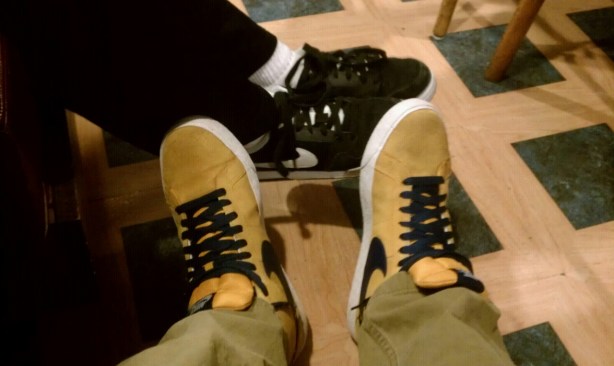
Out to tacos w/ the boy! Nike Sb Blazers Gold Leaf & 6.0 Morgan Jr on that #dadlyfe
Out to tacos w/ the boy! Nike Sb Blazers Gold Leaf & 6.0 Morgan Jr on that #dadlyfe
We are well into the new year and the folks in Beaverton are on an absolute tear. Part of that tear is this new Air Max 1 that is said to be part of a Nike Track & Field Collection. This collection is inspired by and paying tribute to Athletics West & Steve Prefontaine. Featuring a simple two tone color blocking of black and reflective 3M material these are perfect for the spring rainy season approaching in many locales. No exact release date is known but comment below if these are a cop for you!

Here is a look at the PYS x New Balance Mint Condition 574s that DROPped last night at midnight. Taking design cues from Ronnie Fieg’s now famous color blocking these 574s are definitely neck breakers. Premium suede wraps the shoe in black and light mint with both black and mint laces included. The real kicker on these is the details. PYS branding on the tongue with the words mint condition. Also inside the tongue is a # of 96 as that is the total number of pairs made. The New Balance box is also co-branded with PYS and the package is topped off with a PYS x Good Wood bracelet. These sold out in minutes last night but you can still score a pair over on ebay in a size 11.5 here.
The UK/US brand New Balance seems to really be pushing for the sneakerhead market of late. Once limited to euro only releases for their more fashion forward releases, the running brand is coming out with previews of a pack every week it seems. Here we look at a fall DROP of the 577 model called the Farmer’s Market Pack. The 577 has often been overshadowed by the popularity of the 574 model but these definitely do not disappoint. Featuring earthy tones and premium materials they are perfect for fall and the change of weather. Anyone else counting down the days to fall for these already?

Here we take a look at a Nike Sportswear offering that focuses on a sport you don’t hear a ton about in the sneaker game: Lacrosse. This bright version of the classic 90s runner is sure to snap necks this spring with its blue and lime hits and awesome argyle lining. I am a sucker for argyle and will definitely be waiting for this one to DROP. Thanks to InsideLacrosse.com for the heads up on this release.


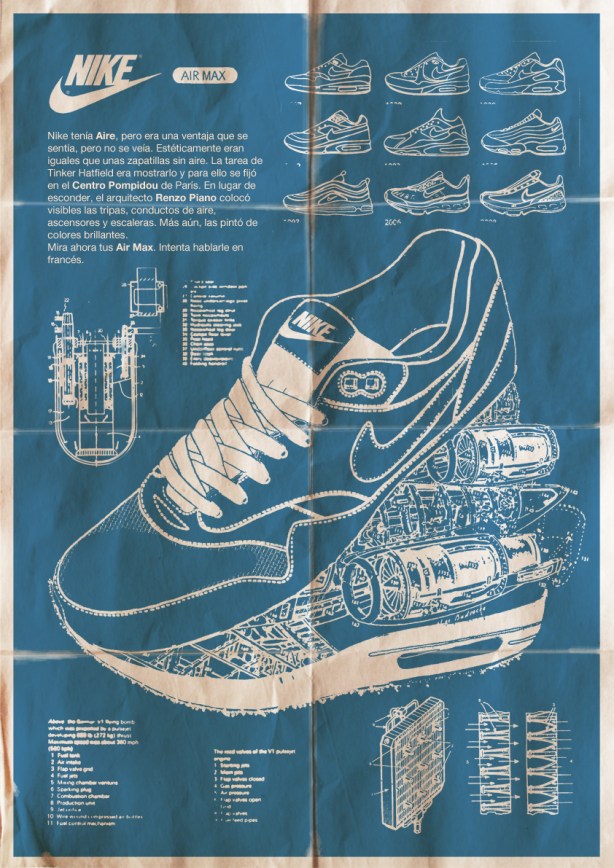
Nike Air Max Poster
Will be very interesting to see what this #makeitcount (by nike) is on Thursday!

Sneaker Art: The Original Jumpman. Peep this watercolor by Cory Deitrick (deitrixartworks@gmail.com). Cousin of a buddy of mine and I guess he did this in minutes. Kid’s got crazy talent!
Well I have been slacking a bit compared to other sites but you gotta do a best of list! I took a lot into account when making this list such as style, hype, and more. I didn’t get to cop all the DROPs on my list but there is definitely a leaning towards ones that I did. Here it goes:
10. Jordan XI Retro Concords

What can I say, I bought into the hype a little. I have never been a giant fan of the XIs as my Jordan love mostly stops at VIIIs but this is just an iconic shoe. The first of the XIs that Mike wore these are neck snappers. Featuring a primarily white make up with the toe wrapped in black patent these sneakers literally caused riots. Moms were leaving babies in their cars, people were pepper spraying each other, and mall doors were broken down. When a sneaker release makes the 6 o’clock news on every major news network they have to be on your best of list!
9. Packer Shoes x Reebok Court Victory Pump – French Open

New Jersey’s Packer Shoes has always had a tendency to do collaborations a little different than others and this shoe is no exception. This one is actually part of a 4 shoe pack of Reebok Court Victory Pumps called the Grand Slam pack. Each shoe in the pack features some sort of ode to the signature of the tennis major tournaments. For the French Open version they just took it to the extreme. The shoe features a fairly typical 90s makeup of the Court Victory with one not so subtle difference……clay splatter all over. IMO this was just genius in design and a perfect tribute to the clay courts of the French Open. I don’t have a pair yet but I am not sure how much longer that will last.
8. Jordan Retro III White Cement

Iconic. The Jordan III is simply an historical shoe and this color way was the first to release back in 1988 when Jordan and Tinker Hatfield changed the world forever. Tumbled leather, elephant print, and the first Jumpman logo this one had it all. Jordan also wore this shoe for his iconic free throw line slam dunk contest dunk that defined a generation. This is a classic that would sell well if they released it every year and while you may see another iteration of it on my list, it had to be here. If Mike calls it one of his all time favorites who am I to argue?
7. Nike Air Trainer SC II Retro – Infrared & Citron

Lucky #7 on the list is the Nike Air Trainer SC II in the 2 original color ways. These are another release that hasn’t been seen in forever….21 years to be exact. The trainer series has always been a big seller for Nike since the days of Bo Jackson turning heads in multiple sports. We saw a few other DROPs of this shoe in new colors in 2011 but the OG heads wanted the, well, OGs. DROPPING in both the citron and infrared color palettes these were a big pleaser to a lot of sneakerheads who remember the days of Bo Knows or even Mars Blackmon but surprisingly weren’t as big of a hit with the younger heads. Sad in theory but great if you missed them originally both of these colors are still available in a full size run on nike store at a significant discount.
6. Ronnie Fieg X Asics Gel Lyte III Leatherbacks

If you were doing a best of list of sneaker collaborators Ronnie Fieg would be at the top of a lot of people’s lists and this shoe definitely has something to do with it. Featuring absolutely buttery leather and smooth suede this shoe is a site. Teased over and over again the hype was strong when Ronnie DROPPED this shoe back in November and I was lucky enough to score a pair. While not as much of a contrast as the Salmon Toes seen later on the list these still have that Ronnie “splash” as he likes to say. The bright blue sole really stands out against the somewhat muted upper and depending on your lace choice can be a bright or subtle neck breaker around the world.
5. New Balance Made in America M574 American Tall Tales Pack

Bringing in the midpoint on the list is actually a pack of 2 shoes from New Balance. The American Tall Tales Pack of M574s paid tribute to folk legend in America by way of Paul Bunyan and his faithful companion Babe the Blue Ox. The former featured a brown and creme makeup of smooth suede with a gum outsole that really makes them shine. The kicker on this first shoe was the red and black plaid inner liner reminiscent of a lumberjack flannel like Paul Bunyan wore. The second shoe of the pack features an all over suede in several shades of blue for obvious reasons. These made the list for style but they also are the only shoe on this list that was made in the USA. I’d like to see more brands bring some manufacturing back home since most of them are designed here.
4. Jordan Retro III Black Cement

If you are reading this list you bought this shoe. Greatest sneaker design ever in my opinion and there is just not much more to say about them. The black tumbled leather. The elephant print. The visible air unit. The Jumpman logo. TIMELESS
3. Jordan VII Retro Bordeaux

There were a ton of great Jordan brand retros in 2011 and more will be featured on this list but I had to give top billing to the Retro VII Bordeaux. This colorway just screams late 80s to early 90s and this year was the first retro since the original DROP in 1991. These shoes were on MJs feat when he was featured in another famous MJs video for “JAM” and feature all over suede with a crazy color combo not previously seen on basketball shoes at the time. The Bordeaux was an interesting release as a lot of the kiddos who weren’t born when the originals came out passed on them. To those that are in the know and actually grew up watching the GOAT play though, these were a no brainer.
2. CNCPTS x New Balance 999 Kennedy

Boston’s CNCPTS takes the second spot on my list with a shoe that topped many people’s lists for 2011. No stranger to sneaker design with the Lobster SB runs of the past CNCPTS really did it right with the nautical theme on this New Balance 999. There is a reason every brand you can think of has done something nautical themed, it works. Featuring a red, white, blue, and tan palette, flag logos, and a custom liner these dropped back in April to critical acclaim. Even John Mayer was seen rocking a pair. I know I was on the phone all day trying to cop my pair with no luck. The 999 has seen other great collabs in the past and I am sure 2012 will bring us another!
1. Ronnie Fieg X Asics Gel Lyte III Salmon Toe

From the first time I saw a tweeted pic of these shoes I was in love. Something about the contrast of the salmon and the navy just POPS. Ronnie had quite the year in sneaker design as well as opening his Kith retail spots so it’s only appropriate that he topped this list. Premium materials and straight forward designs are his signatures and I am a fan of most of it. Props to Ronnie for topping many lists this year and I can’t wait to see what’s DROPPING in 2012!
ITS BEEN A GREAT YEAR IN SNEAKERS. CAN’T WAIT FOR 2012. STAY TUNED TO DROPDSM.TUMBLR.COM TO FIND OUT WHAT’S NEXT!
Follow up featuring Part II of a great look at Supreme. LINK
In Part I, we examined how New York-based streetwear company Supreme became a global cult brand with its own myths, iconography and belief systems. Today, we explore the creative and commercial philosophies that underpin Supreme’s lasting success, courtesy of our friends at 032c.
NEW YORK, United States — The mythology behind legendary New York streetwear brand Supreme is so potent, it’s easy to imagine founder James Jebbia as a king pin of downtown Manhattan. But as he will be the first to tell you, that couldn’t be farther from the truth.
In fact, Supreme’s core creative and business philosophies are the sum of Jebbia’s patchwork retail past; not, as one might assume, a storied legacy in skateboarding. His resume reads like a series of interconnected Google-map pins on a late-80s and early-90s SoHo New York. A British-transplant who arrived in New York around 1984, Jebbia got a job working at the now-defunct Parachute clothing store in SoHo.
“I didn’t know what I was doing, but I knew I enjoyed clothes,” he says. He quit five years later to open, along with his girlfriend at the time, a small flea market on Wooster Street inspired by the myriad of stuff he coveted from The Face and i-D magazines. The project evolved into his first proper store, Union, an experimental shop on Spring Street that carried “mostly English brands” and one very important streetwear juggernaut at the time by the name of Stüssy. This allowed Jebbia to work with Shawn Stüssy, who asked him to partner with him to open one of his eponymous boutiques on Prince Street in 1991.
When Stüssy left the business, Jebbia opened up Supreme in 1994 in a small storefront on Lafayette, a then-desolate street that was a perfect place for his clientele to skate first, shop second – an order that would very quickly be reversed. “I opened Supreme because there were no other decent skate shops around at the time,” Jebbia says. “I thought, cool, I might as well be the one to do it.”
The store was able to become the holy grail of high youth street culture by curating a mix of the city’s iconography – fashion, music, celebrity and politics – within its walls and then instantly sledge-hammering the city’s high-low playing field.
Limited-edition Damien Hirst skateboards are around the same price as decks featuring lyrics from Public Enemy; custom Spalding basketballs might be sold under the artist Nate Lowman’s gritty canvases hanging on the wall. The brand’s iconic T-shirts, like everything in the store, have become collector’s items that are collages of controversial provocations and heady imagery. Designs have included an oversized New York Times logo, a portrait of Kate Moss, lyrics from the reggae musician Lee “Scratch” Perry, Mickey Mouse’s hands praying with rosary beads, Budweiser labels, and alarmist political slogans such as “Illegal business controls America.”
Juxtapositions abound: images of naked girls playing with a hose pop up in a calendar from 2006 but more cerebral women like Chloë Sevigny and Jenn Brill act as brand ambassadors in Japanese style magazines; one of the brand’s most iconic image is of the rapper Raekwon, an Elmo doll, and an Uzi show by the photographer Kenneth Capello. And really, who would have thought Lou Reed would ever become the label’s face, as he did in 2009?
“Supreme embraces the outsider and always does things off-value from their brand,” says Richardson. “But they’re consistent and have always embraced the outsider and the individual. At the end of the day, Supreme is about the legacy of punk through skateboarding and you can really genuinely feel this in everything they do.”
The brand’s insidery-outsidery brilliance often made them precursors to trends that would later pop-up on the catwalk, such as their collaboration with Richard Prince as part of their art deck series well before Prince joined forces with Marc Jacobs to make handbags. “I like to point that out,” Jebbia says with a smile. “Not to be that guy, but just, you know, to point it out.”
The Supreme brand and its products soon became viable forms of creative expression, which in turn became catnip for a particular breed of male consumer hungry for that indefinable but high-quality cool, resounding most immediately with Japan.
“We never purposefully went after a Japanese customer,” Jebbia says. “It wasn’t like that. It’s always been about that really picky New York customer, but I think that translates all over the world.” Nonetheless, the Japanese consumers hyper-related to Jebbia’s choosy modus operandi and were quick to embrace the Supreme product as something culturally valuable and worth a premium price. “Japanese kids respect underground movements and have a good eye for it,” says Bondaroff.
Supreme now has five stores scattered across Japan and just opened their first store in London, featuring installations from the artists Mark Gonzales and Ari Marcopolous, this past September. “We’ve always really been inspired by London youth,” says Jebbia. Evidence of his grimy South London influence can be seen in many of the Supreme staples, such as military jackets, beanies, and oversized Oxford shirts with a neat fit.
But there is also a business component to setting up shop across the pond. “For us, London is the real gateway to Europe,” Jebbia says. Now kids won’t have to fly from all over Europe to come to New York to get a piece of Supreme. “We hope it makes things easier for them, honestly. It can save them a plane ticket, you know what I mean? But, we’re keeping the shop with the same spirit, it will feel like New York.”
In the past, owning a piece of clothing with the red Supreme logo on it was like a more authentic “I Love NY” T-shirt, a tourist token that instantly made you feel a part of a certain downtown New York ethos. Jebbia is mindful of this, but he doesn’t seem worried about diluting the potency of his brand by going global: “We’re not going to open up stores everywhere, that’s just not us. I can’t even think of somewhere else I would like to open, really.”
Supreme has been able to grow, but Jebbia has always been able to keep his hand right on the faucet, letting out just enough but not too much. “Supreme represents fresh ideas done right,” says Kenneth Capello. “They’re always one step ahead and always limited, so people want it.”
Mr. Jebbia, however, is playfully cautious about the idea that his small production runs are part of an exploitative plan to skew supply and demand to fever-pitch levels. “The main reason behind the short runs is that we don’t want to get stuck with stuff that nobody wants,” he says. But admitting to a kind of customer trickery isn’t exactly the coolest thing to say, so you let him be. “Let me put it this way,” he adds tellingly. “We work really, really hard to make everything seem effortless.”
As the shop is on the horizon of its second decade in business, all that hard work has become the focal point for a type of New York aesthetic that is just now entering the canon of great American dressing. When it first opened, the shop was a reflection of the times: the raw energy of Larry Clark’s film Kids; the haphazard elegance of grunge; the polished grit of the East Coast hip-hop movement of the time. In Jebbia’s conversation with Glenn O’Brien from the piece in Interview he asked me to read, Jebbia spoke about the lasting influence of that era in his brand’s sensibility:
“There’s always, I think, a sense of the early-90s to it. That era is definitely a big influence running though everything we do – that was a really special time. And since we started back then, I think it’s fine for us to always look to that era and get a lot of influence from it. It’s not nostalgic – it’s more like it’s a part of us.”
It’s been almost 20 years since the birth of this aesthetic, and now, with most menswear designers aimlessly searching in tea-soaked history books for authenticity, it has never felt more right. If Polo reflects a sense of country club prep and A.P.C. a type of louche French rock ’n’ roll (two brands Jebbia says he greatly admires), Supreme has then its own unique form of authentic, time-encapsulated style in early-90s skate culture.
But now, the baggy pants are a little bit more fitted; the Oxford shirts come in a more sophisticated palette of colours; the imagery is more mature. And while other designers such as Rag & Bone, Tommy Hilfiger or J.Crew hark back to a phantom sense of American heritage, Supreme actually embodies a new garde of American classicism without dwelling in dusty clichés. The little skate-shop-that-could has unexpectedly grown to foster one of the strongest statements in men’s sportswear – the hallmark of American fashion – in quite some time.
“People think that because we are widely-known as a skate shop, our clientele must be idiots. But they want new things on a high level. All they care about is quality,” says Jebbia.
He is right, after all. Today, the globalized customer demands a certain tasteful efficiency, not the trappings of exclusivity. To date, Supreme has chosen to refine their signature products, not to forge themselves out in wild, unpredictable directions with their design process, but instead to forge themselves out in new directions in the world at large. “The product keeps getting better and better,” Bondaroff told me in a phone interview. “It’s so solid now, it crosses over to so many different types of people depending on how they want to wear it.”
Solid, in this case, means well-proportioned sportswear without a lot of frill; done with a discerning eye for what is wearable – take a long-sleeved double-ply flannel in yellow, brown, or green, for example. Therein lies Supreme’s striking paradox. Underneath its tough exterior, the brand has always traded on something of cool’s polar opposite: pragmatism and utility – with a keen sense of graphics and sharp design, no doubt.
The crucial thing to know about Supreme clothes is that they reflect everyday style for men. But more importantly, they assuage the fears many men who have come of age alongside the store have about wanting to look grown up – or, dare I say, appropriate – while still being true to their core aesthetic values that Jebbia speaks of. Almost two decades later, the Supreme project has become an updated take on that oh-so American sense of function and pragmatism. It’s a design philosophy that has mostly been missing in men’s fashion in recent years.
“Quality” is a word Jebbia stresses over and over again in conversations about his brand. You get a sense that he is growing impatient with just being known for on-the-nose artist collaborations or an effervescent downtown credibility. His brand’s true worth, and what his customers fetishize above anything else, is its casual matter-of-factness. Nothing looks sharper, but there is nothing snobby about that. There is something universal about it, really. If fashion and award shows have any teachable moments, it’s that cool doesn’t last on the fickle world stage. Quality does.
“It’s not really just a cool skateboard thing anymore. People resist that idea still. It frustrates me,” Jebbia says before taking a pause. “Oh well.”
 DropDSM